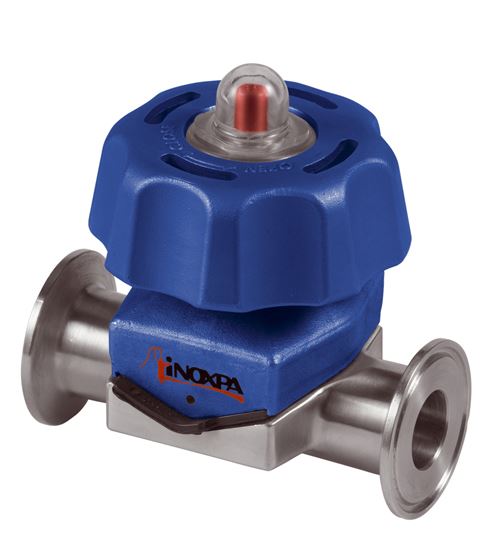
The diaphragm provides the body seal as well as the seat seal.
There are no paths to the outside environment and, as such, the valve is suitable for aseptic processes.
When the valve is being closed, a pressure pad which supports the diaphragm moves towards the sealing face on the body.
As the pressure plate moves, the diaphragm flexes and is forced down onto the seat area in the centre of the body, thus, closing off the flow path through the body.
The inter-relationship of body to the pressure plate prevents over compression of the diaphragm.
The valve can be actuated either manually or pneumatically and controlled by control tops and solenoid valves.
Straight through flow path. High Kv factor.
Controlled compression of sealing. Compact actuator.
Normally closed (NC) pneumatic actuator (standard).
Sealed actuator with no maintenance required (stainless steel version).
Leak detector.
Position indicator.
Interchangeability of parts.
Ergonomic handle.
Standard connections: weld and clamp OD / DIN.
Traceability of components.
Parts in contact with the product: AISI 316L
Other stainless steel parts: AISI 304
Plastic parts: PP + 30 GF
Diaphragm: EPDM according to FDA 177.2600 and USP Class VI
Internal surface finish: Ra ? 0,5 ?m
External surface finish: mirror polish
Available sizes: DN ?? - DN 2?
Max.working temperature: (St.St. actuator) -20 ?C to +90 ?C (EPDM) -4 ?F to 194 ?F +140 ?C (SIP, max. 30 min) 284 ?F
Max.working temperature: (plastic actuator) +80 ?C (EPDM) 176 ?F
Max.working pressure: (according to the model) 10 bar 145 PSI
Compressed air pressure 6-8 bar 87-116 PSI
Diaphragm valves, manually or pneumatically operated, are specially designed for use in hygienic and aseptic processes in the food-processing and pharmaceutical industries.
The valve is excellent for flow control as well as for open/close duties.
Diaphragm Valve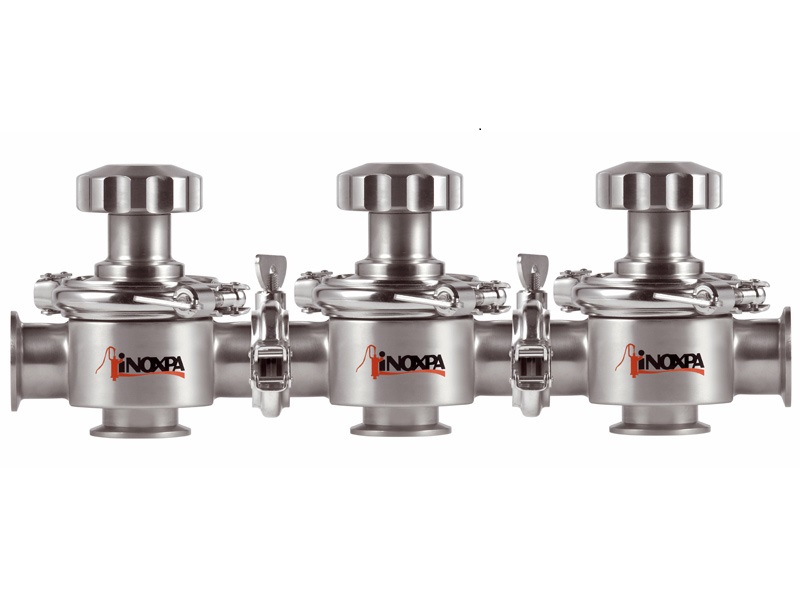 Radial Diaphragm Valve
 Flexible Hose Valve Pinch